
Tatting Fern


I have recently become enamored with Wordles.
A Wordle is a visual depiction of words in a “word cloud” from text that you provide. It seems to be a great way to quickly understand the essence of a person in word-form. I got the idea after visiting a cemetery. Most of the tombstones that I saw had a descriptor such as ‘wife’, ‘mother’, ‘daughter’, etc. I got to thinking about what one or two words that I would want to represent me forever, actually ‘carved into stone’, and realized that there are sooooooo many more descriptors needed to adequately get an idea of who I am/was, as is true for everyone. So, I created this Wordle using descriptors/labels that represented my life. Since creating this, I decided to keep a list of attributes that I think represent me.
Karen Kay Reuter Bovard Sayre: TheShuttleSmith, Mother, Wife, Daughter, Sister, Aunt, Tatter, Sewer, Embroiderer, Fiber Artist, Lacemaker, Needlelacer, Motorcyclist, Sidecarist,
Motorcycle Safety Instructor, Dirt Biker, Trials Rider, Electron Microscopy Technologist, Neuropathology Technologist, 4-H Member, Smocker, Designer, Author, Publisher, Silversmith, Enamelist, Christian, Gardener, Teacher, Dana College Graduate, Lapidarist, Tatting Shuttle Maker, Nebraskan, Iowan, Farm Girl, One-Room Country School Student, Wisner-Pilger Gator, Baton Twirler, Piano/Guitar/Banjo/Mandolin Player, Farmer’s Daughter, Divorcee, Single Mother
I think that it is important to look at an individual as the sum of their parts. The above descriptors are the parts of my life, some more important to the whole than others, but still parts. I keep adding to the list as my life changes….but I never take away a descriptor.
It seems to me that a Wordle would be a great tombstone….I’m looking into this concept in the future.


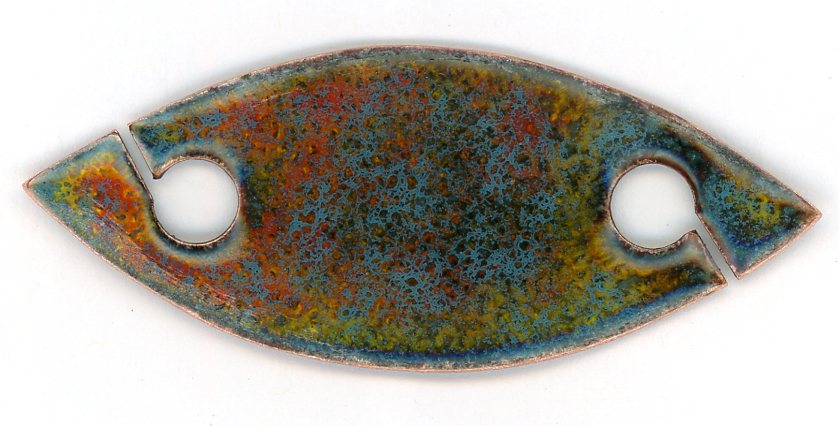
This is one of my first ‘crackle’ shuttles and is actually quite a complex design.
The base is probably a clear, transparent enamel which allows the copper metal to shine through. The coloration is a mix of a transparent blue, opaque red and yellow.
I have been trying for quite some time to create ‘crackle’ effect in my enameled shuttles. Just recently I have been able to achieve some success.
The technique of ‘enamel crackle’ is fickle. It’ more of an art than a science, but in actuality it’s relies on a lot of physics that really are not completely understood. Each color of enamel has different properties that may vary from batch to batch.
Getting crackles in your enamel depends on the use of at least two layers of different enamels which have different coefficients of expansion (COE)–told you physics was involved. The crackle effect is produced using a base coat of enamel with a very low coefficient of expansion (which means it flows/ moves readily sooner than other enamels would at the same temperature). After firing this ‘lower COE’ enamel, a top coat of usually two different colors of enamels with a slightly higher COE is applied and fired to a high temperature for a longer period of time. If the enameling-gods are with you, you will get a ‘crackle glaze’ look!
Watch for future posts of the crackle enamel tatting shuttles I have been producing. I will also be posting on my FB page: ShuttleSmithTatting


I USED to get and see comments to my posts. Now I don’t. I want this website to be interactive…not just what I post!!!!
So……how do I enable ‘comments’ on this my WordPress-generated website?
I swear that trying to figure out how to use social media is at least a part time job…time that I just don’t have right now.
If someone can help me (you can’t leave your suggestion in comments–hah!), please email me at: k.bovard@yahoo.om
This is the red thread color-bleed that I encountered while trying to block my solid apple design. Since this was one of 5 different designs in my ‘Spokane Beauty Apple‘ series, I was concerned about what would happen when I blocked other designs in which an area of white tatting was incorporated into a design with areas of red thread (as seen in the second photo).


Color-bleeding happens when fibers get wet and dye leaches out into the water.
In general, there are several reasons why color-bleed can happen:
Red dyes in general are not more prone to bleeding than similar dyes of other colors. The problem is that red-dyed fibers are often dyed with a kind of dye called ‘direct dye’. Direct dye, whatever its color, tends to bleed in every wash, unless the fibers have been treated with a special cationic dye fixative. Using only cool water for washing will help, because higher temperatures decrease the ability of direct dye to remain associated with fabric. Avoid direct dye, as well as all-purpose dye, which contains direct dye. Instead, use a fiber reactive dye.
For us as tatters, the why of color-bleed is really of no concern–the damage to the thread is done. The issue is how can we control the color-bleeding? How do we avoid color bleed from one area of a tatted piece into a different color region? (eg. My apple examples above.)